Case of contextual advertising setup for an Internet provider in Dnipro
How to increase macro conversions by 50% without changing the budget
#PPC
Input data
Client: Internet provider in Dnipro.
Term: 2 months.
Team: project manager, PPC specialist, web analyst, designer, editor.
Problem: the client had a stable advertising budget, but the number of macro conversions was low, and some of the campaigns in the search and display networks did not give the expected results due to untargeted traffic and a lack of optimization for specific services.
Tasks:
The setting of advertising on the Google Search Network and Google Display Network.
Optimize ads and audiences to maximize macro conversions.
Set up remarketing, placement exclusion lists, and responsive ads to improve the effectiveness of your advertising campaigns within your budget.
Lists of works
1
/
Created separate searching campaigns for every service category.
2
/
Started a branding campaign in which keywords were used with the provider's name.
3
/
Selected overall negative keywords list which is used in the account.
4
/
Created relevant advertisements (extended text and adaptive). Added dynamic advertisements for the biggest users’ coverage.
5
/
Added all of the possible advertisements extensions.
6
/
Added fixation data by audiences in the Google Ads search network.
7
/
Created several lists for remarketing, such as “all site visitors”, “visitors of the page of some service”, and “users who made conversion”.
8
/
Campaigns have been set up for purpose (to connect the Internet and TV), and all of the interested buyers of the telecommunications services.
9
/
The categories of applications have been removed, and general minus lists of placements for GDN campaigns have been added.
10
/
Created adaptive designs display ads.
11
/
Optimized advertising companies in the search and contextual media network.
Results
After launching and optimizing advertising campaigns, we received the first data on macro conversions and their cost, which allowed us to adjust the strategy and determine the most effective ad formats and audiences for further scaling results.
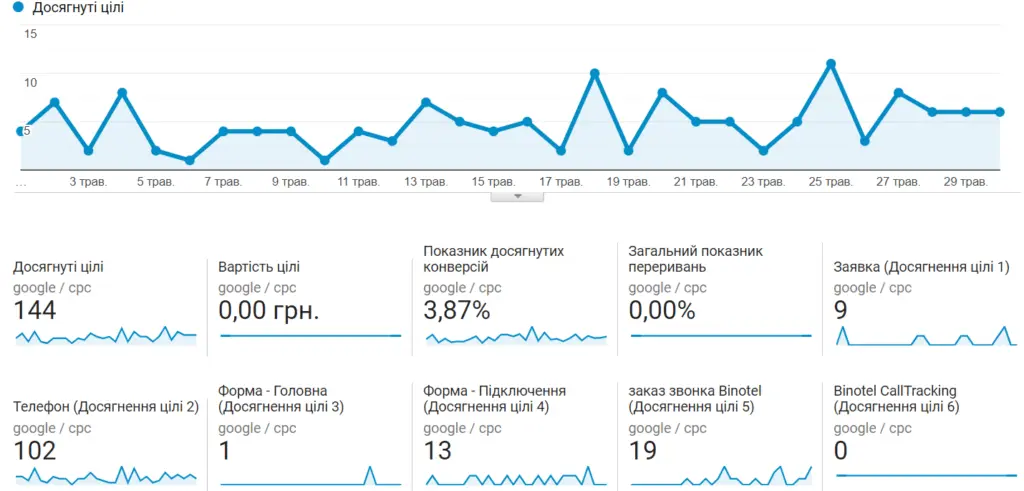
In the first month, we got 42 macro conversions (included requests, filled out forms and the Binotel call-back). At the first time, the smart campaign bringed a little traffic and the price of click was higher than in the searching advertisement.
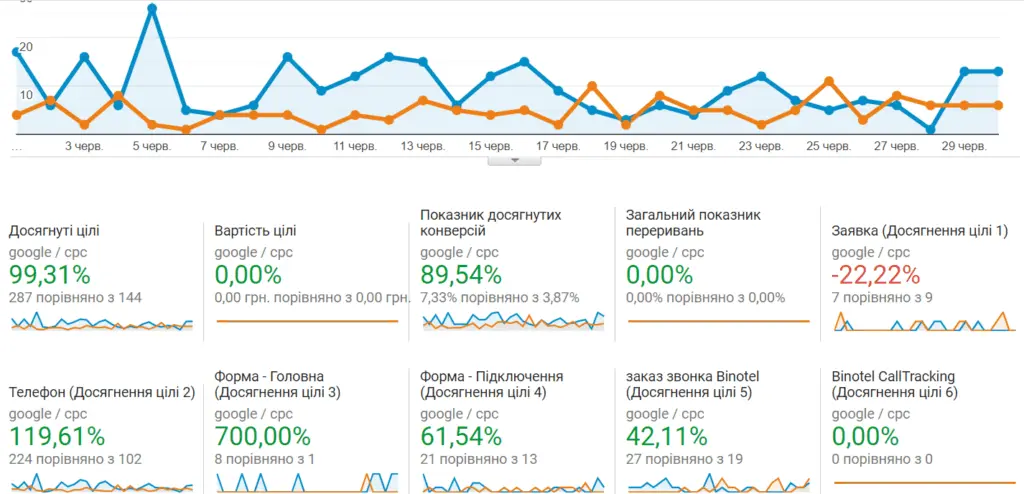
In the second month, the number of macro conversions increased by 50%, 63 macro conversions with the same budget. The smart campaign showed a good result – almost third of the total number of conversions. At the same time, the price of macro conversions in the second month decreased by 26%.
Results
After launching and optimizing advertising campaigns, we received the first data on macro conversions and their cost, which allowed us to adjust the strategy and determine the most effective ad formats and audiences for further scaling results.
In the first month, we got 42 macro conversions (included requests, filled out forms and the Binotel call-back). At the first time, the smart campaign bringed a little traffic and the price of click was higher than in the searching advertisement.
In the second month, the number of macro conversions increased by 50%, 63 macro conversions with the same budget. The smart campaign showed a good result – almost third of the total number of conversions. At the same time, the price of macro conversions in the second month decreased by 26%.
Conclusion
Comprehensive optimization of search and GDN campaigns allowed an Internet provider in Dnipro to increase the number of macro conversions without additional budget and reduce the cost per conversion. The use of responsive ads, intent targeting, remarketing audiences, and placement exclusion lists ensured a steady increase in the effectiveness of advertising campaigns and an increase in the number of targeted applications.
Do you want the same?
Order an individual consultation to discuss your project!
Order